You are not logged in. Please register or login.
- Topics: Active | Unanswered
#161 Re: The Sunset Strip » What Are You Listening To? » 512 weeks ago
Felix Jaehn - Ain’t Nobody
#162 Re: The Garden » The United Kingdom General Election, 2nd May 2024 » 512 weeks ago
@atarilegend
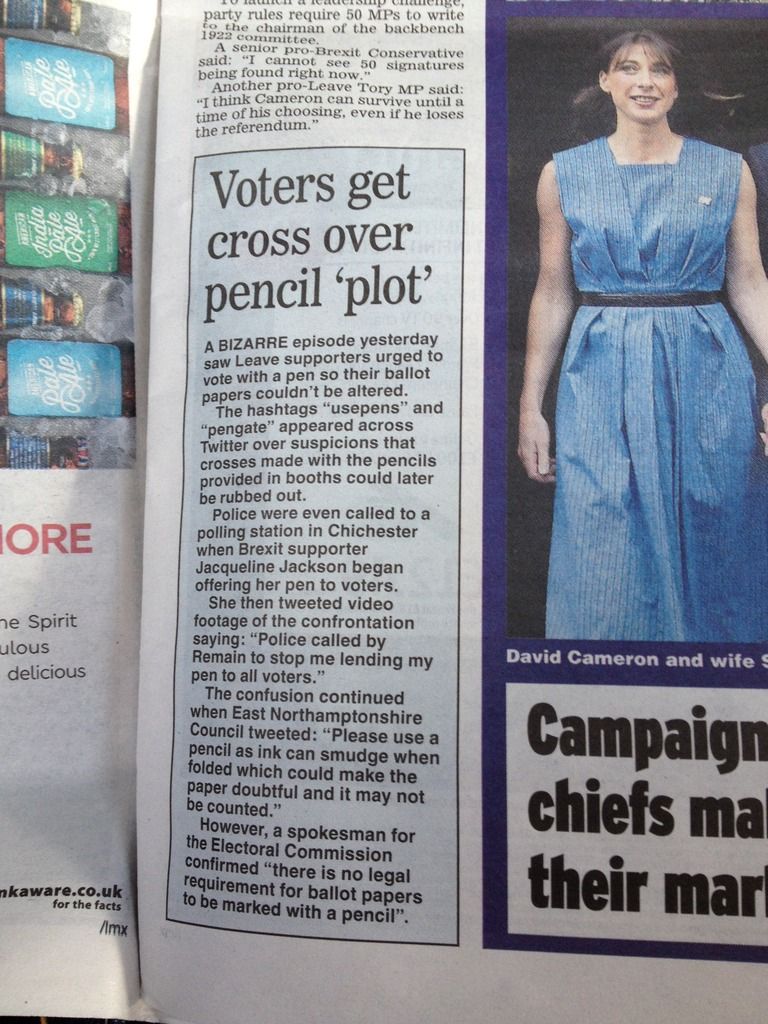
I saw this in a paper today and thought of you
#163 Re: The Garden » The United Kingdom General Election, 2nd May 2024 » 512 weeks ago
“The younger generation has lost the right to live and work in 27 other countries. We will never know the full extent of lost opportunities, friendships, marriages and experiences we will be denied. Freedom of movement was taken away by our parents, uncles and grandparents in a parting blow to a generation that was already drowning in the debts of its predecessors.”
I haven't lost this right. 
#164 Re: The Garden » The United Kingdom General Election, 2nd May 2024 » 512 weeks ago
EU leaders call for UK to leave as soon as possible
A senior EU leader has confirmed the bloc wants Britain out as soon as possible, warning that David Cameron’s decision to delay the start of Brexit negotiations until his successor is in place may not be fast enough.
Martin Schulz, the president of the European parliament, told the Guardian that EU lawyers were studying whether it was possible to speed up the triggering of article 50 of the Lisbon treaty – the untested procedure for leaving the union.
As the EU’s institutions scrambled to respond to the bodyblow of Britain’s exit, Schulz said uncertainty was “the opposite of what we need”, adding that it was difficult to accept that “a whole continent is taken hostage because of an internal fight in the Tory party”.
“I doubt it is only in the hands of the government of the United Kingdom,” he said. “We have to take note of this unilateral declaration that they want to wait until October, but that must not be the last word.”
Other top EU leaders have said they expect the UK to act on its momentous vote to leave the union “as soon as possible, however painful that process may be” and that there will be “no renegotiation”.
The presidents of the European council, commission and parliament – Donald Tusk, Jean-Claude Juncker and Martin Schulz respectively – and Mark Rutte, the prime minister of the Netherlands which holds the EU’s rotating presidency, said any delay to Britain’s exit would “unnecessarily prolong uncertainty”.
After emergency talks in Brussels, the four said they regretted, but respected Britain’s decision.
“This is an unprecedented situation, but we are united in our response,” they said in a joint statement.
While the UK – the first sovereign country to vote to leave – would remain a member until exit negotiations were concluded, they said, Europe expected it to “give effect to this decision ... as soon as possible” by triggering article 50 of the Lisbon treaty, which is effectively Britain’s formal letter of resignation.
The special settlement negotiated by David Cameron earlier this year was void and could not be renegotiated, they said.
In Berlin, the German chancellor, Angela Merkel, expressed “great regret” at Britain’s decision, but said the EU should not draw “quick and simple conclusions” that might create new and deeper divisions. The union’s foundation was “the idea of peace”, she said.
Speaking in Paris, the French president, François Hollande, said he “profoundly regrets” the Brexit vote but that the EU now had to make changes. In a brief televised statement, Hollande said the vote would put Europe to the test: “To move forward, Europe cannot act as before.”
Schulz said he would speak to Merkel about “how to avoid a chain reaction” of other EU states following Britain.
“The chain reaction being celebrated everywhere now by Eurosceptics won’t happen,” he said, adding that the EU was the world’s biggest single market and “Britain has just cut its ties with that market. That’ll have consequences, and I don’t believe other countries will be encouraged to follow that dangerous path.”
The vote “causes major damage to both sides”, Weber said. “Exit negotiations should be concluded within two years at max. There cannot be any special treatment. Leave means leave.”Manfred Weber, the chairman of the European People’s party group of centre-right parties in the European parliament, stressed that Britain had crossed a line and there was no going back.
Tusk said earlier that the EU’s 27 remaining members would meet next week to assess their future without Britain, warning that there was “no way of predicting all the political consequences of this event – especially for the UK. It is a historic moment, but not a moment for hysterical reactions.”
For 40 yrs #UK relation with #EU was ambiguous. Now it's clear. Will of voters must be respected. Now need speedy & clear exit negotiation
— EP President (@EP_President) June 24, 2016">
Germany’s foreign minister, Frank-Walter Steinmeier, called the result “truly sobering … It looks like a sad day for Europe and the United Kingdom.”
Sigmar Gabriel, the head of Germany’s Social Democrats, Merkel’s coalition partners, said the British vote was a “shrill wake-up call” for European politicians. “Whoever fails to heed it or takes refuge in the usual rituals, will drive Europe against the wall,” Gabriel said.
The Belgian prime minister, Charles Michel, called for a special “conclave” of EU leaders as early as next month. “We need to keep a cool head and need to see what new way of cooperation would be possible,” he said.
The Polish foreign minister, Witold Waszczykowski, said in a statement the result showed “disillusionment with European integration, and declining trust in the EU”.
He sought to reassure at least 850,000 Poles living in Britain that “during talks (...) we will aim to guarantee the rights citizens have acquired”.
Italy’s prime minister, Matteo Renzi, tweeted: “We must change it to make it more human and more just. But Europe is our home, it’s our future.” Lars Loekke Rasmussen, the Danish prime minister, said Denmark “belongs in Europe” but said mounting Euroscepticism must be taken seriously.
In Greece, there was concern that the referendum result would intensify anti-European sentiment. “In the short term, Brexit may help Greece, because our allies will want to solidify and show solidarity,” a senior minister told the Guardian. “But in the long term, it will not. The prospect of Grexit will increase.”
Turkey, whose future membership of the EU played a key role in the UK referendum campaign, cast doubt on the likelihood of it joining in the aftermath of the Brexit vote. “The European Union’s disintegration has started,” deputy prime minister Nurettin Canikli tweeted. “Britain was the first to jump ship.”
The UK was the EU’s second-largest economy and largest military power. It will embark on the process of leaving as the union grapples with multiple crises: huge numbers of migrants, economic weakness and a nationalist Russia seeking to overturn the post-cold war order.
Brussels will look to Germany and France to show the world that Europe is still in business. Italy is likely to also play a role in crisis talks, although Spanish elections on Sunday rule out much input from Madrid.
Cameron said in his resignation speech on Friday morning that it would be up to his successor, likely to be appointed within the next three months, to trigger article 50. Once that is done, the clock starts running on two years of negotiations.
The UK has to negotiate two agreements: a divorce treaty to wind down British contributions to the EU budget and settle the status of the 1.2 million Britons living in the EU and 3 million EU citizens in the UK; and an agreement to govern future trade and other ties with its European neighbours.
Tusk has estimated that both agreements could take seven years to settle “without any guarantee of success”. Most Brussels insiders think this sounds optimistic.
There were early warnings of difficulties ahead. The German MEP Elmar Brok, who chairs the European parliament’s committee on foreign affairs, told the Guardian the parliament would call on Juncker to strip the British commissioner, Jonathan Hill, of the financial services brief with immediate effect and turn him into a “commissioner without portfolio”.
“They will have to negotiate from the position of a third country, not as a member state. If Britain wants to have a similar status to Switzerland and Norway, then it will also have to pay into EU structural funds like those countries do. The British public will find out what that means.”
Jean-Claude Piris, a former head of the EU council legal service, said claims that Britain would get unfettered access to the single market, without free movement of people, were the equivalent of believing in Father Christmas. The British “cannot get as good a deal as they have now, it is impossible.”
Some Brussels insiders fear France and Germany may soften their approach after the vote. Others think countries, especially France, will push for a harsh settlement to hammer home the price of leaving.
One likely outcome of negotiations is that banks and financial firms in the City of London will be stripped of their lucrative EU “passports” that allow them to sell services to the rest of the EU.
However, on paper, nothing changes immediately. The UK remains an EU member until it has finalised the terms of its divorce and is obliged to follow all EU rules.
In theory, the UK retains the decision-making privileges of membership; in reality, power will rapidly drain away and British diplomats can expect to be marginalised in the councils of Brussels.
The UK will keep its veto in some areas, such as tax and foreign policy, but diplomats say Britain’s voice on other EU decisions, for example economy and business, will count for little.
#165 Re: The Garden » The Randomness Thread » 512 weeks ago
Gluten seems to be in everything. 
#166 Re: The Garden » The United Kingdom General Election, 2nd May 2024 » 512 weeks ago
You're definitely paranoid, mate. 
#167 Re: The Garden » The United Kingdom General Election, 2nd May 2024 » 512 weeks ago
Understanding the anti-immigrant mindset
Updated June 23, 2016 2:12 PM
As Britain decides whether to leave the European Union, it is clear that one issue created the greatest source of tension: immigration.
British attitudes toward immigration have been changing for some time, and especially since the European Union expanded to include many of the former communist countries of Eastern Europe. According to the British Social Attitudes Survey, in 1995, 63 percent of the British public were in favor of reducing immigration. By 2008, this had risen to 78 percent, where it has stabilized.
For a country built on a long history of inward migration — from the Flemish textile workers of the 14th century through the Commonwealth workers of the 20th — this change has been surprising and has been attributed to economic unease. But this may not be the case.
In a recent paper, researchers from the London School of Economics addressed the issue that often appears at the heart of public concerns: jobs and wages. Over a period in which the number of people from the EU living in Britain tripled - to 0.9 million in 1995 to 3.3 million in 2015 — there was no adverse impact on British workers in terms of a substitution of foreign-born labor for native British labor. While there had certainly been labor market pain, it wasn’t a result of immigration but of the slow recovery from the global financial crisis.
EU immigrants are, on average, better educated than the native-born population. They are more likely to have a job and to pay more in tax than they receive in benefits and public services. A study of 22 Organization for Economic and Cooperation and Development countries published last year found that immigration boosts productivity growth. Applying the findings to Britain suggests that halving Britain’s immigration would knock 0.32 percent off productivity growth each year. The LSE authors wrote:
“We can confidently say that the empirical evidence shows that EU immigration has not had significantly negative effects on average employment, wages or inequality for British people.”
advertisement | advertise on newsday
Looking beyond Britain and the narrower question of EU migration, economic evidence published by the American Economics Association suggests that lowering barriers to freedom of movement could add more to the global economy than any other form of market liberalization, including the free movement of goods and capital.
In research published this week, pollsters Ipsos MORI found that 46 percent of Britons think that the economy has benefited from EU immigration compared with only 30 percent who think the opposite. Less than one in four believe that EU immigration has had a negative effect on local areas. The positive economic arguments, it seems, haven’t fallen on deaf ears.
But asked whether immigration from the EU has been “good for Britain on the whole,” the survey reveals a much deeper division: four in 10 believe that immigration has been positive, with an equal number believing that it has been bad (20 percent either don’t know or think it’s neutral). According to the British Social Attitudes Survey, “more than half of people (54 percent) who see immigration as good for the economy also want to see immigration reduced.”
Whatever happens with Thursday’s vote, a debate over immigration is likely to be at the heart of U.K. politics for some time to come. Opinions are complicated, and not necessarily dictated by logic. But even Britons fearful for their futures don’t necessarily think immigration has come with an economic cost. In a year of turmoil and unease, this is at least something to build on.
#168 Re: The Garden » The United Kingdom General Election, 2nd May 2024 » 512 weeks ago
It was scary last night... Floods of rain and thunder.
It won't be a massive victory for pro EU voters.
Referendum LIVE: Remain ahead by 4% in final poll - but it’s close
#169 Re: The Garden » The United Kingdom General Election, 2nd May 2024 » 512 weeks ago
Less than 2 hours to go.
Voters stranded by rail problems
The problems at London transport hubs could potentially affect the ability of thousands of people to vote.
Waterloo, where there appears to be no service at all, serves 90 million passengers a year, which is about 250,000 a day on average (although the average obviously includes weekends and holidays).
Cannon Street, Charing Cross, London Bridge, Victoria, and probably other stations have also been affected. They are all major commuter stations with many people likely to have left for work this morning before polls opened.
The Rail Delivery Group says among the train operators affected are Abellio Greater Anglia, Gatwick Express, Southern, South West Trains and Thameslink.
Among those stranded is the broadcaster and journalist Sian Williams.
#170 Re: The Sunset Strip » What Are You Listening To? » 512 weeks ago
Isaac Hayes - Shaft
